Microservice environments

Give every service the scheduling model it needs.

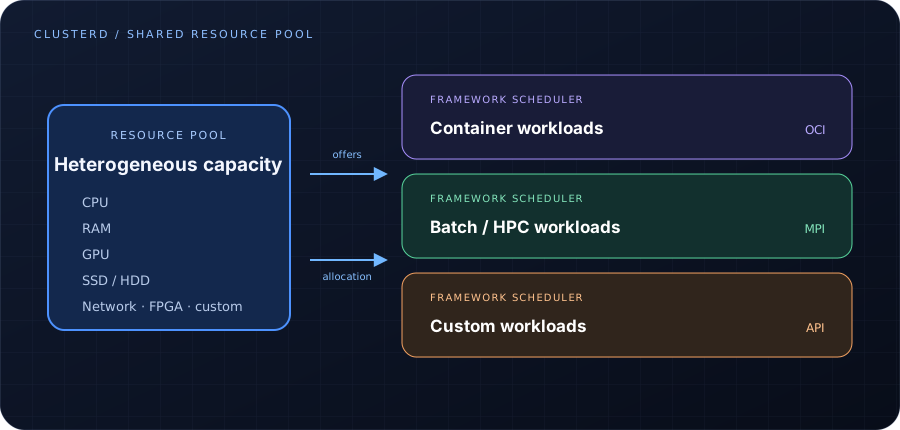
ClusterD provides a shared resource layer for distributed applications. Its two-level model keeps resource coordination in the cluster while frameworks make workload-specific placement and lifecycle decisions. That separation makes room for container services, batch and HPC jobs, GPU workloads, and specialised executors in one heterogeneous cluster.

One cluster, diverse services

A resource layer that does not prescribe your application platform.

Microservice environments combine services with different runtime, scaling, placement, and operational requirements. ClusterD lets them share CPUs, memory, ports, and other resources without forcing every workload through a single application scheduler. Framework schedulers can apply the logic that fits their own services while ClusterD coordinates the underlying node pool.

A shared ClusterD resource pool provides CPU, RAM, GPU, storage, network and custom resources to independent container, batch and custom schedulers
Resources are pooled centrally; each framework chooses how its workload uses the capacity it receives.
01 / RESOURCE SHARING

Share capacity without flattening workloads.

Run distributed applications on a dynamically shared pool of heterogeneous nodes. CPU, memory, GPU, storage, network and custom resources can be represented and governed with roles, weights, reservations and quotas.

02 / SCHEDULING

Keep application decisions close to the application.

ClusterD managers expose available resources to registered frameworks. Framework schedulers answer the workload questions—where, when, how many, and which resources—while executors perform the work.

03 / CONTAINERS

Choose the execution path.

Containers are one workload type, not the platform boundary. Use the native Mesos® containerizer or Docker containerizer, and build other execution paths through framework and executor APIs.

04 / OPERATIONS

Use established cluster primitives.

High-availability masters, maintenance primitives, quotas, reservations and observability provide the operational foundation for a shared cluster resource pool.

05 / SECURITY

Build on explicit security controls.

SSL support, authentication, authorization, and secrets management are available platform capabilities for deployments that need controlled access to cluster infrastructure.

06 / OPEN SOURCE

Keep the infrastructure inspectable.

ClusterD continues Apache Mesos® as an open, framework-driven cluster manager. Teams can inspect the implementation and adapt the scheduler layer to their own needs.

Practical paths

Meet teams where they build services.

ClusterD can serve as the shared infrastructure below different application platforms. OCI, CNI and CSI keep container, network and storage integration open, while framework APIs keep workload policy extensible.

Compose-defined services

mesos-compose translates its documented Compose 3.9 feature set into ClusterD workloads, including replicas, resource limits, ports, volumes, networks, health checks, and placement constraints.

Kubernetes through mesos-m3s

mesos-m3s runs K3s/Kubernetes components as framework-managed workloads and supports multiple independent framework instances on ClusterD.

Custom frameworks

Scheduler and executor APIs allow teams to build or extend a framework when their services need their own placement and lifecycle logic.

Standout features & differentiators

What makes ClusterD distinct for microservices.

  • Two-level scheduling: resource coordination stays central while frameworks retain workload-specific scheduling control.
  • A genuinely shared resource pool: multiple distributed applications can use the same nodes, CPUs, memory, and ports.
  • Framework choice: use Compose-defined services, Kubernetes through mesos-m3s, or a custom framework instead of a single prescribed platform.
  • Explicit resource governance: roles, weights, reservations, and quotas organize shared infrastructure.
  • Containerizer flexibility: choose the native Mesos® containerizer or Docker containerizer on a cgroups v2 foundation.
  • Maintained Apache Mesos® lineage: ClusterD carries the open, framework-driven architecture forward for modern Linux and container environments.