One pool. Many frameworks.
Share CPUs, memory, ports, and other resources across distributed applications without forcing every workload into a single scheduler.
ClusterD carries the proven Apache Mesos® model forward—efficient resource isolation and sharing across distributed frameworks, built for modern Linux systems.
Follow the focused installation guide for a minimal Debian-based setup.
Open QuickstartSome infrastructure ideas outlast the trend cycle. ClusterD preserves the Mesos® two-level scheduling model while maintaining the system for today's Linux and container environments.
Share CPUs, memory, ports, and other resources across distributed applications without forcing every workload into a single scheduler.
cgroups v2 is the required resource-control foundation from ClusterD 1.11.0-0.6.0 onward.
Run workloads through the native Mesos® containerizer or integrate with the Docker containerizer.
High-availability master setups, maintenance primitives, quotas, reservations, and observability are documented parts of the platform.
Build with CMake, enable SSL support, study the implementation, and contribute under the Apache License 2.0.
$ cmake -DUNBUNDLED_LIBEVENT=true \
  -DENABLE_SSL=true -DENABLE_LIBEVENT=true ../
$ makeScheduler and executor APIs let teams implement framework-specific placement and lifecycle logic rather than forcing every workload through one orchestration model.
List agents, inspect running tasks, and retrieve cluster state directly from the command line.
./clusterd-cli agent list lists the active agent synthetic-agent-001 at node-01.example.test../clusterd-cli framework list --all lists three active synthetic frameworks and one archived synthetic framework../clusterd-cli task list --all shows synthetic-task-running in TASK_RUNNING state and synthetic-task-finished in TASK_FINISHED state../clusterd-cli compose list synthetic-compose shows the demo:web:frontend task running on node-01.example.test../clusterd-cli m3s status synthetic-m3s --m3s --kubernetes reports a healthy m3s cluster with one server and two agents, followed by a ready Kubernetes cluster with three nodes../clusterd-cli task inspect synthetic-task-running returns JSON identifying its synthetic executor, framework, agent, and TASK_RUNNING status.The new React-based WebUI brings the cluster overview, tasks, frameworks, agents, resources, and master details together in a modern interface with light and dark themes.

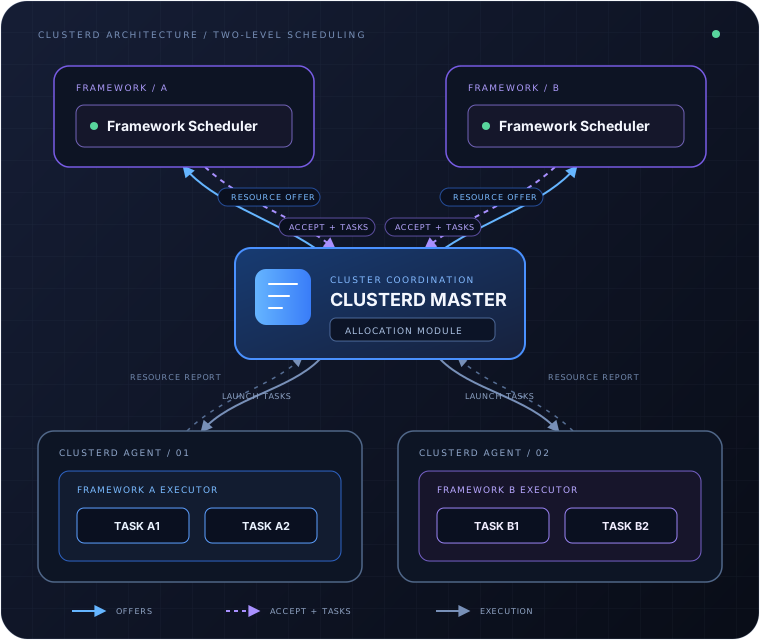
ClusterD separates resource coordination from application scheduling. Masters offer resources; framework schedulers decide what to run; agents execute the work.
Understand the architectureMasters track agents and make available resources visible to registered frameworks.
Each framework applies its own workload-specific scheduling logic.
Agents launch and isolate tasks across the dynamically shared node pool.

“Good infrastructure should not disappear just because the industry moves on to its next idea.”
ClusterD exists to keep the Apache Mesos® architecture maintained, secure, and useful for the people who depend on it.
AVENTER provides professional ClusterD support as well as architecture and software development for integrations, extensions, and project-specific requirements.
Read the operational documentation, install from the package repository, or join the project on Matrix.